Hombre Cósmico artwork by Ricardo Santos Hernández

Hombre Cósmico

El Hombre Cósmico is a recurring presence across Ricardo's work — a being who carries the memory of the earth and the vision of the stars, always in migration back toward his ancestral land.

This series draws its inspiration from the 1925 vision of Mexican philosopher José Vasconcelos, who envisioned the emergence of a fifth race — born of the racial and cultural mixing of Indigenous, European, African, and Asian roots. Vasconcelos called this being El Hombre Cósmico: a new humanity defined not by material or military dominance, but by love, beauty, and spirituality.

Each work in this series explores that theme through a different technique, material, and visual language — painting, printmaking, drawing, mixed media — yet all share the same soul: a figure at the crossroads of the human, the ancestral, and the cosmic.
Hombre Cósmico — Ricardo Santos Hernández. Lithograph, printed at Hoof Print Chicago with Gabe Hoar. The cosmic man: a figure at the intersection of the human, the ancestral, and the universe. Rooted in Chicano and Indigenous cosmology, the Hombre Cósmico is a recurring presence across Ricardo's work — a being who carries the memory of the earth and the vision of the stars. by Ricardo Santos Hernández
Hombre Cósmico — Ricardo Santos Hernández. Lithograph, printed at Hoof Print Chicago with Gabe Hoar. The cosmic man: a figure at the intersection of the human, the ancestral, and the universe. Rooted in Chicano and Indigenous cosmology, the Hombre Cósmico is a recurring presence across Ricardo's work — a being who carries the memory of the earth and the vision of the stars.
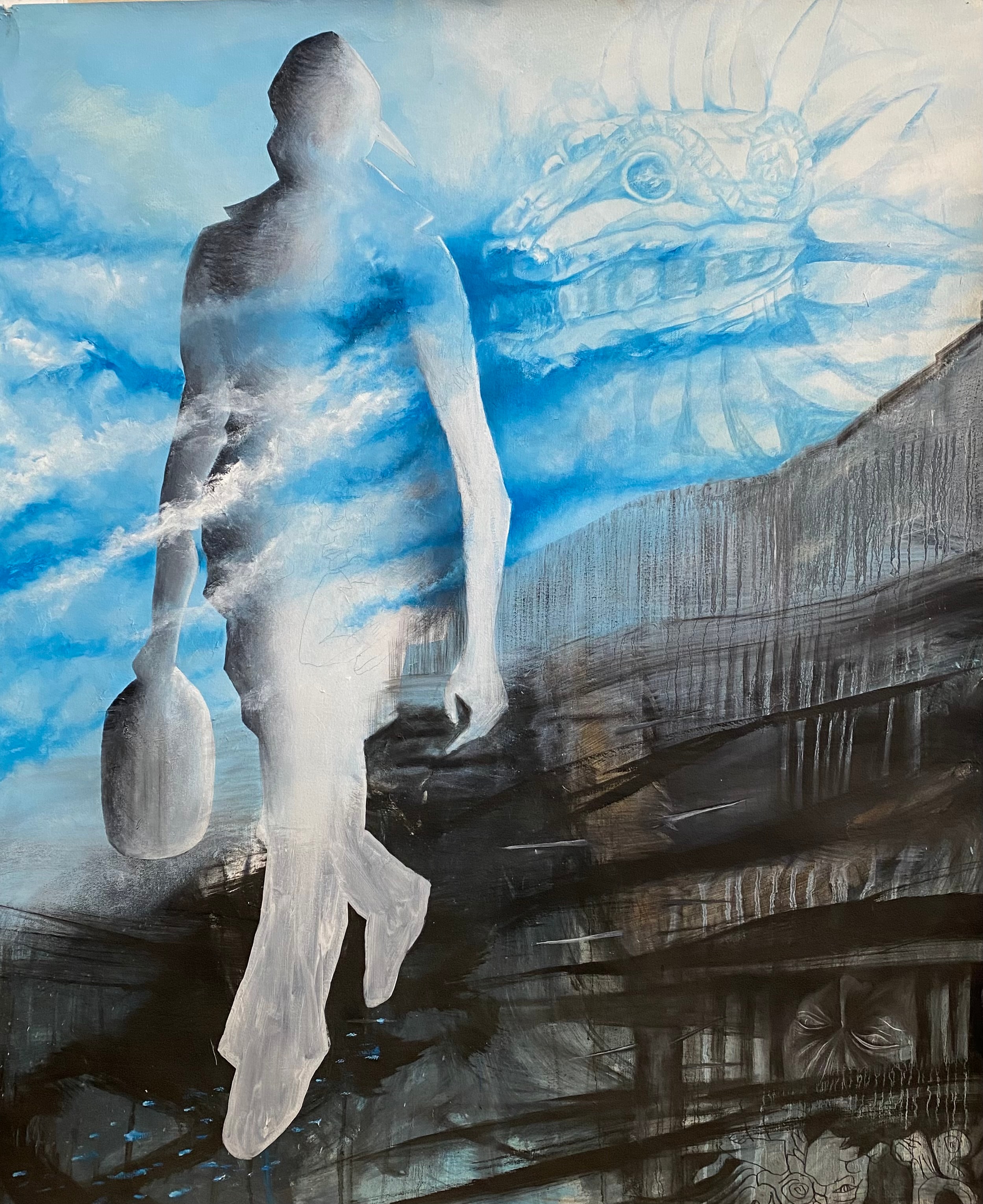
Hombre Cósmico: He Knows the Secret of the Trails — Ricardo Santos Hernández. Oil paint on multi-purpose paper. A translucent figure strides forward carrying the weight of the journey — his body made of sky and cloud, barely separate from the world around him. Above and behind him, Quetzalcóatl emerges from the blue: the feathered serpent, keeper of ancient knowledge, guardian of the path. Below, the earth is dark and layered — the ruins of what was crossed, the faces of those who watch. He knows the secret of the trails: not the roads drawn on maps, but the ones written in the body, passed down through generations of migration and return. by Ricardo Santos Hernández
Hombre Cósmico: He Knows the Secret of the Trails — Ricardo Santos Hernández. Oil paint on multi-purpose paper. A translucent figure strides forward carrying the weight of the journey — his body made of sky and cloud, barely separate from the world around him. Above and behind him, Quetzalcóatl emerges from the blue: the feathered serpent, keeper of ancient knowledge, guardian of the path. Below, the earth is dark and layered — the ruins of what was crossed, the faces of those who watch. He knows the secret of the trails: not the roads drawn on maps, but the ones written in the body, passed down through generations of migration and return.
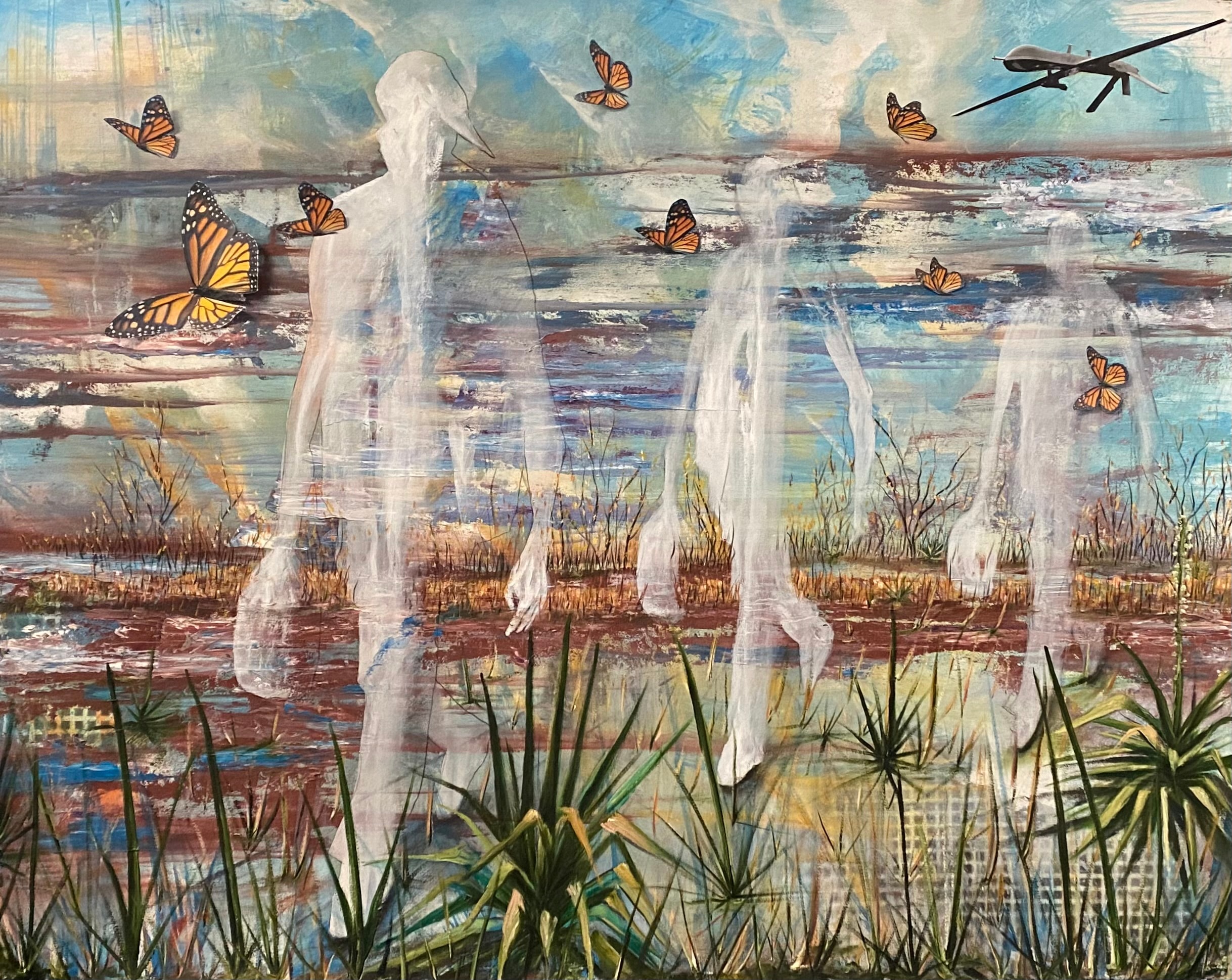
Hombre Cósmico and Monarch Butterflies Going Home — Ricardo Santos Hernández. Oil paint, collage on multi-purpose paper. Translucent figures of the Hombre Cósmico move through a wetland landscape alongside monarch butterflies in migration — all journeying back toward ancestral land. A military drone crosses the sky above, a silent witness to the crossing. The monarchs and the cosmic beings share the same path: a return guided not by borders, but by memory, spirit, and the pull of the earth. by Ricardo Santos Hernández
Hombre Cósmico and Monarch Butterflies Going Home — Ricardo Santos Hernández. Oil paint, collage on multi-purpose paper. Translucent figures of the Hombre Cósmico move through a wetland landscape alongside monarch butterflies in migration — all journeying back toward ancestral land. A military drone crosses the sky above, a silent witness to the crossing. The monarchs and the cosmic beings share the same path: a return guided not by borders, but by memory, spirit, and the pull of the earth.
Hombre Cósmico — as published in El Exito, Chicago's Spanish-language newspaper (now dismantled). A rare document of Ricardo's work reaching the Chicano community through one of the city's most important Spanish-language voices. The image carries the weight of that moment — art and community press bearing witness to each other. by Ricardo Santos Hernández
Hombre Cósmico — as published in El Exito, Chicago's Spanish-language newspaper (now dismantled). A rare document of Ricardo's work reaching the Chicano community through one of the city's most important Spanish-language voices. The image carries the weight of that moment — art and community press bearing witness to each other.
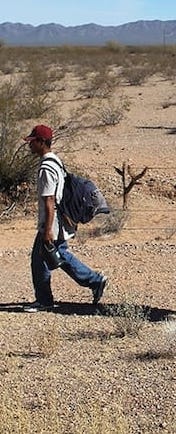
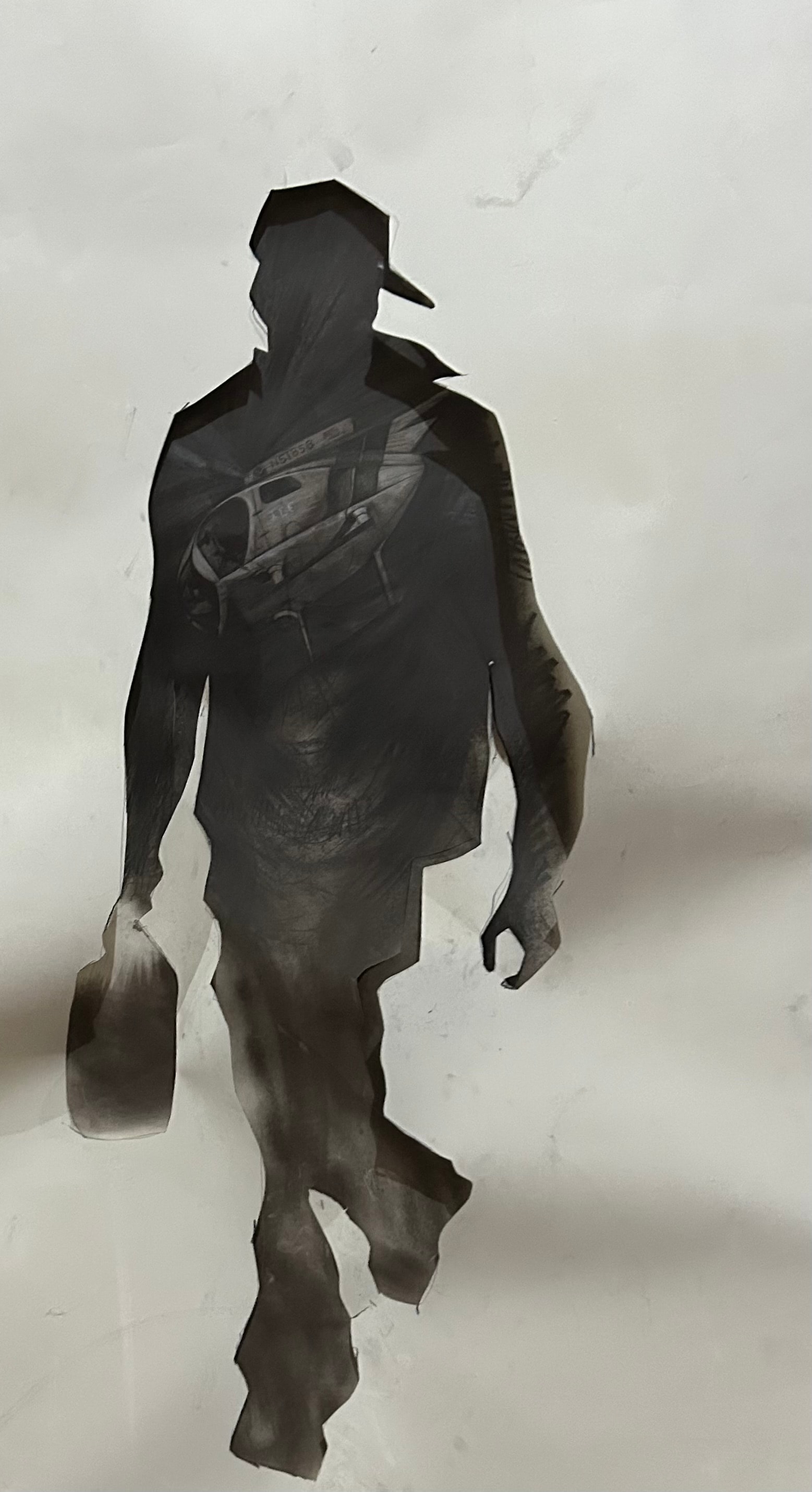
Hombre Cósmico: The ICE Helicopter Is Only a Deterrent — Ricardo Santos Hernández. Graphite sticks, graphite powder on Arches. Large-scale work. A monumental silhouette strides forward — hat low, bag in hand, the body of a man in motion. Inside that body, embedded in the graphite darkness of his chest, an ICE helicopter hovers. It does not stop him. It does not define him. It is only a deterrent — a machine of fear absorbed into the figure and carried forward, rendered powerless by the sheer force of the Hombre Cósmico's movement. The Arches paper holds the graphite like skin holds memory: layered, smudged, indelible. by Ricardo Santos Hernández
Hombre Cósmico: The ICE Helicopter Is Only a Deterrent — Ricardo Santos Hernández. Graphite sticks, graphite powder on Arches. Large-scale work. A monumental silhouette strides forward — hat low, bag in hand, the body of a man in motion. Inside that body, embedded in the graphite darkness of his chest, an ICE helicopter hovers. It does not stop him. It does not define him. It is only a deterrent — a machine of fear absorbed into the figure and carried forward, rendered powerless by the sheer force of the Hombre Cósmico's movement. The Arches paper holds the graphite like skin holds memory: layered, smudged, indelible.
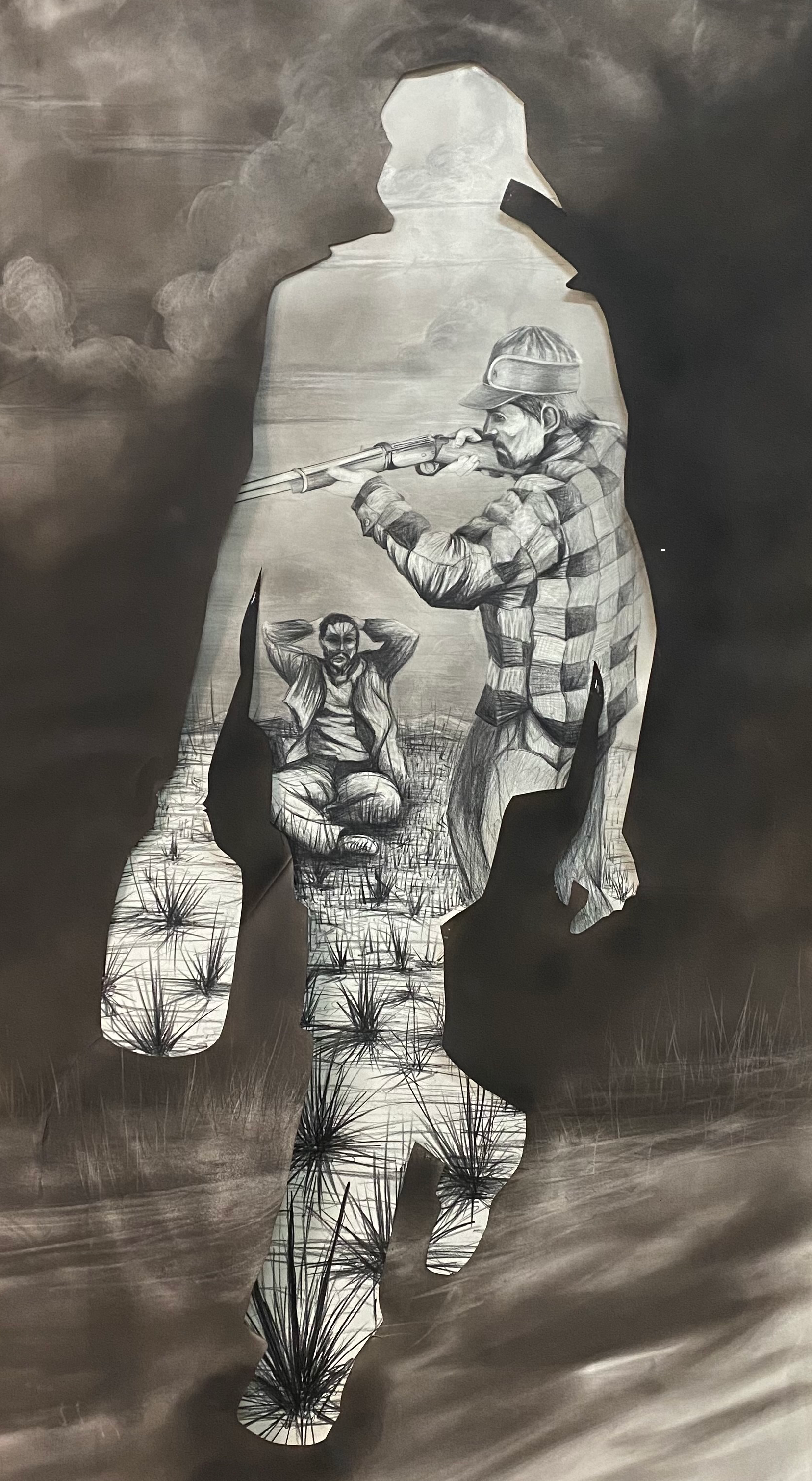
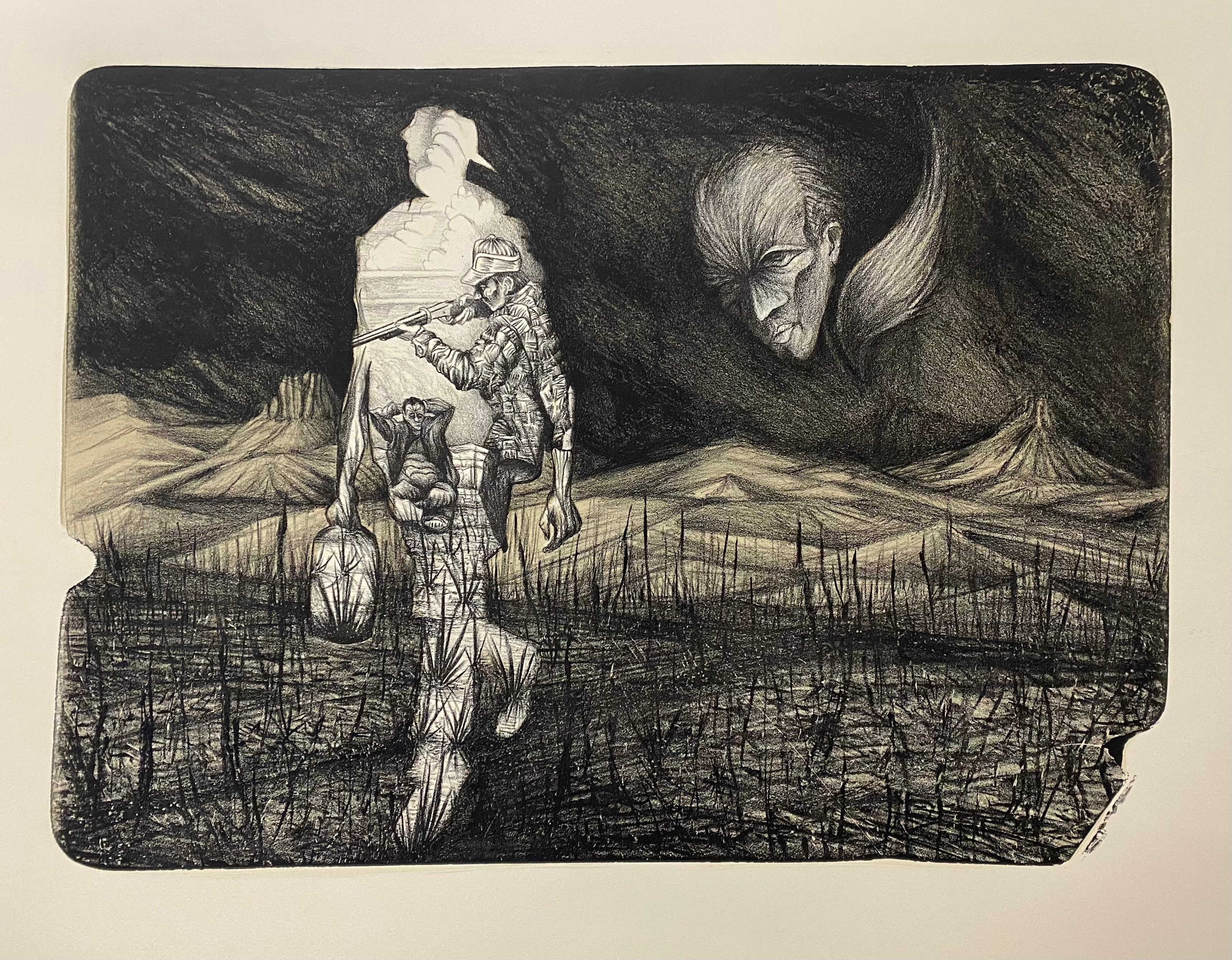
Hombre Cósmico: A Study for the Lithograph "He Knows the Secret of the Trails" — Ricardo Santos Hernández. A preparatory study in graphite. The silhouette of the walking man contains a world of violence within it: a hunter in a plaid jacket raises a rifle at a kneeling figure, hands raised, surrounded by desert grasses. The body of the Hombre Cósmico is not just a vessel — it is a landscape, a history, a scene of confrontation carried forward with every step. This study reveals the thinking behind the lithograph: the trails he knows are not safe. They are the trails where power meets the powerless, where survival is not guaranteed. He walks anyway. by Ricardo Santos Hernández
Hombre Cósmico: A Study for the Lithograph "He Knows the Secret of the Trails" — Ricardo Santos Hernández. A preparatory study in graphite. The silhouette of the walking man contains a world of violence within it: a hunter in a plaid jacket raises a rifle at a kneeling figure, hands raised, surrounded by desert grasses. The body of the Hombre Cósmico is not just a vessel — it is a landscape, a history, a scene of confrontation carried forward with every step. This study reveals the thinking behind the lithograph: the trails he knows are not safe. They are the trails where power meets the powerless, where survival is not guaranteed. He walks anyway.
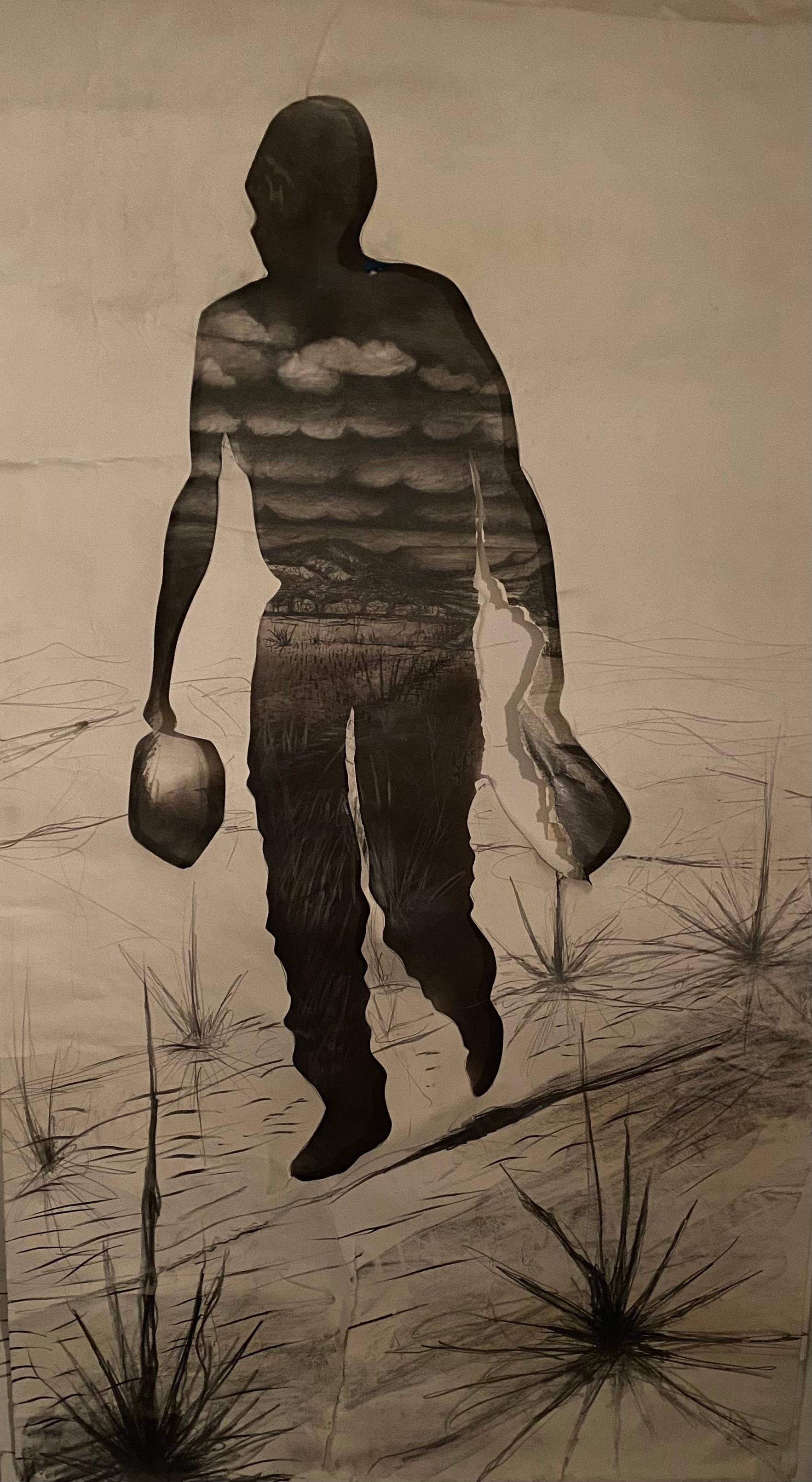
Hombre Cósmico: He Knows the Secret of the Trails — Ricardo Santos Hernández. Large-scale drawing. Graphite sticks, graphite powder on Arches. The silhouette of a man in motion — bag in one hand, hat in the other — fills the sheet from edge to edge. Inside his body, the world he carries: storm clouds layered across his chest, a desert valley stretching through his torso, the horizon line of mountains running through his hips. Around his feet, yucca plants are sketched into the Arches paper as if the earth itself is reaching up to claim him. He is not separate from the land — he is made of it. The trails he knows are written in his body: the sky, the desert floor, the grasses, the long walk. Graphite sticks and powder give the work its weight — the darkness of the silhouette dense and absolute, the landscape within it luminous by contrast. by Ricardo Santos Hernández
Hombre Cósmico: He Knows the Secret of the Trails — Ricardo Santos Hernández. Large-scale drawing. Graphite sticks, graphite powder on Arches. The silhouette of a man in motion — bag in one hand, hat in the other — fills the sheet from edge to edge. Inside his body, the world he carries: storm clouds layered across his chest, a desert valley stretching through his torso, the horizon line of mountains running through his hips. Around his feet, yucca plants are sketched into the Arches paper as if the earth itself is reaching up to claim him. He is not separate from the land — he is made of it. The trails he knows are written in his body: the sky, the desert floor, the grasses, the long walk. Graphite sticks and powder give the work its weight — the darkness of the silhouette dense and absolute, the landscape within it luminous by contrast.
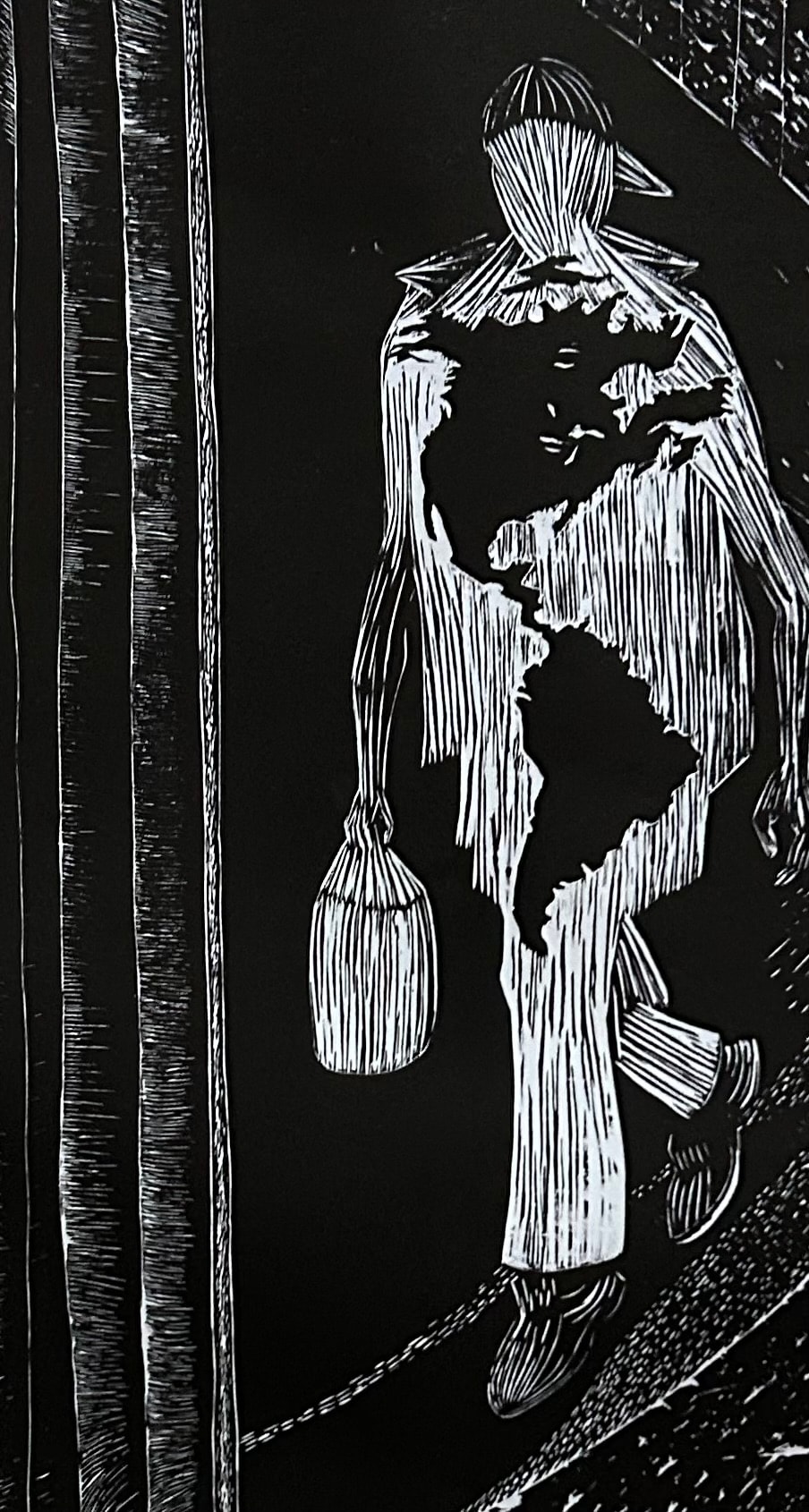
Hombre Cósmico: America Is Our DNA — Ricardo Santos Hernández. Linoleum print, printed at Rene Arceo's print shop, Oak Park, Illinois. The Hombre Cósmico strides forward — bag in hand, body carved from the block in bold white lines against absolute black. Across his chest and torso, the shape of the Americas emerges: the continent is not something he carries, it is something he is made of. A face looks out from within the landmass — a presence embedded in the geography, in the body, in the DNA. The linoleum cut gives the work its force: every line gouged by hand, every mark a decision. Printed in collaboration with master printmaker Rene Arceo, whose Oak Park studio has long been a home for Chicano printmaking and the visual traditions of resistance. by Ricardo Santos Hernández
Hombre Cósmico: America Is Our DNA — Ricardo Santos Hernández. Linoleum print, printed at Rene Arceo's print shop, Oak Park, Illinois. The Hombre Cósmico strides forward — bag in hand, body carved from the block in bold white lines against absolute black. Across his chest and torso, the shape of the Americas emerges: the continent is not something he carries, it is something he is made of. A face looks out from within the landmass — a presence embedded in the geography, in the body, in the DNA. The linoleum cut gives the work its force: every line gouged by hand, every mark a decision. Printed in collaboration with master printmaker Rene Arceo, whose Oak Park studio has long been a home for Chicano printmaking and the visual traditions of resistance.
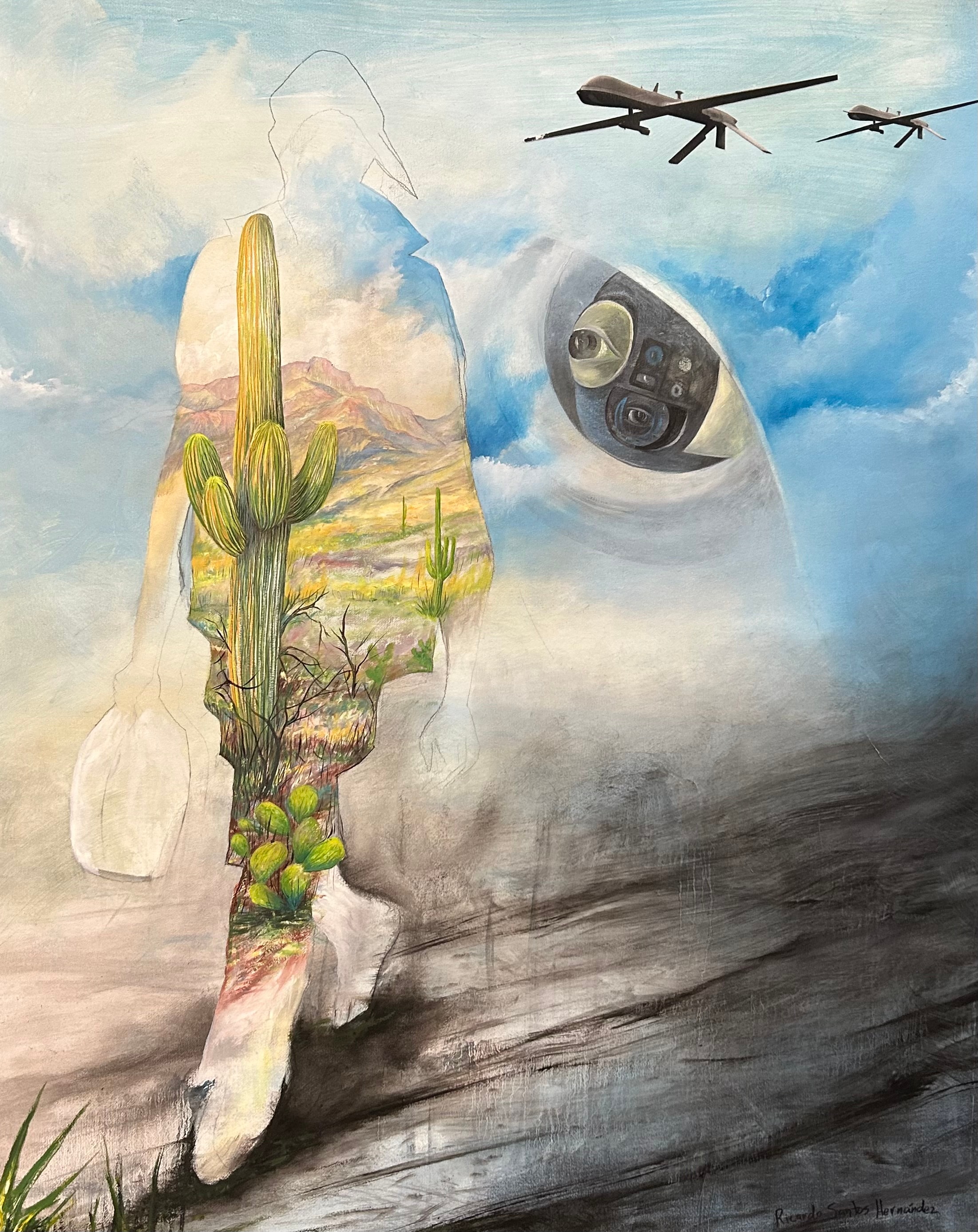
Hombre Cósmico Knows the Secrets of the Desert — Ricardo Santos Hernández. Oil paint, graphite, and collage on gessoed Arches paper. The Hombre Cósmico walks — his body a transparent vessel, a silhouette filled with the Sonoran Desert itself: saguaro cactus rising through his torso, the Santa Catalina Mountains glowing amber and rose across his chest, prickly pear and desert grasses rooting through his feet into the earth. He carries the desert inside him because he is the desert. Above and behind him, the sky is not peaceful — two military surveillance drones cut through the clouds, and a drone camera eye, enormous and mechanical, emerges from the mist like a god of surveillance, its lenses trained on the figure below. The desert he knows is watched. The secrets he carries are contested. Oil paint gives the landscape within him its warmth and luminosity; graphite traces the outline of his body with the lightness of breath; collage brings the drones into the picture plane as documents of the present. He walks anyway — rooted, luminous, surveilled, sovereign. by Ricardo Santos Hernández
Hombre Cósmico Knows the Secrets of the Desert — Ricardo Santos Hernández. Oil paint, graphite, and collage on gessoed Arches paper. The Hombre Cósmico walks — his body a transparent vessel, a silhouette filled with the Sonoran Desert itself: saguaro cactus rising through his torso, the Santa Catalina Mountains glowing amber and rose across his chest, prickly pear and desert grasses rooting through his feet into the earth. He carries the desert inside him because he is the desert. Above and behind him, the sky is not peaceful — two military surveillance drones cut through the clouds, and a drone camera eye, enormous and mechanical, emerges from the mist like a god of surveillance, its lenses trained on the figure below. The desert he knows is watched. The secrets he carries are contested. Oil paint gives the landscape within him its warmth and luminosity; graphite traces the outline of his body with the lightness of breath; collage brings the drones into the picture plane as documents of the present. He walks anyway — rooted, luminous, surveilled, sovereign.